Pad Thai is arguably one of Thailand’s most iconic culinary exports—a dish that seamlessly balances the bold flavors of sweet, sour, salty, and spicy. This national favorite originated in the 1930s amid a period of intense nationalism in Thailand. Then-Prime Minister Plaek Phibunsongkhram promoted Pad Thai as a way to foster a unified national identity, introducing it as a new, uniquely Thai dish during a time of economic hardship. The dish relied on local ingredients and rice noodles instead of rice as part of a broader government effort to reduce domestic rice consumption and increase exports.
Despite its strategic historical emergence, Pad Thai quickly took on a life of its own, becoming a cornerstone of Thai street food culture. It saw countless regional and personal adaptations across the country—and eventually the globe. From the chaotic food stalls of Bangkok to Michelin-starred restaurant menus in Western cities, Pad Thai remains loved for its harmonious composition and satisfying textures.
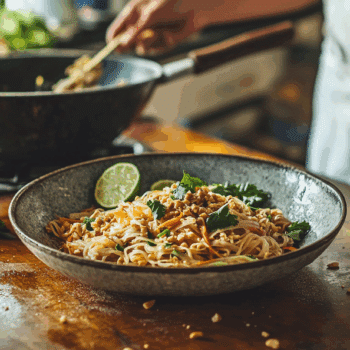
Traditionally, Pad Thai is made with thin rice noodles stir-fried over a high flame with tamarind paste, fish sauce, palm sugar, and sometimes a dash of chili heat. Proteins like shrimp, tofu, or chicken are common choices, along with scrambled egg and a colorful medley of vegetables. The final flourish? A sprinkle of crushed peanuts, fresh herbs, and a few lime wedges for brightness.
In my home kitchen, Pad Thai holds a special place as a weeknight favorite. While I haven’t yet had the chance to visit Thailand, my appreciation for Thai cuisine deepened after watching an episode of Somebody Feed Phil, where Phil Rosenthal savored an authentic bowl at Khlong Lat Mayom Floating Market. The vibrancy of the market and the simplicity of such soul-satisfying street food resonated deeply with me—and ever since, Pad Thai has carried a sense of wanderlust and culinary joy.
My version, while echoing the spirit of authenticity, introduces a modern, health-conscious twist: I use half rice noodles and half thinly sliced cabbage. Not only does this increase the veggie content, but it also adds an effortless crunch that contrasts beautifully with the tender noodles and savory chicken. Additionally, this variation allows the dish to feel lighter without compromising the integrity of its flavors.
It’s important to note that Pad Thai sauce is the beating heart of the dish. Tamarind paste delivers the signature tanginess, perfectly supplemented by the umami depth of fish sauce, the savory-sweet yin-yang of sugar and soy sauce, and a splash of lime for brightness. When this deeply flavorful sauce hits the hot wok and coats the noodles, it creates that ultimate “street food magic” right in your pan.
Topping the dish with crushed peanuts, fresh cilantro, sliced green onions, and lime wedges brings freshness and complexity, making each bite dynamic. Whether you’re a longtime fan or a newbie to Thai cuisine, this Pad Thai with Chicken is an easy-to-love classic that can transport your kitchen to the bustling arteries of Bangkok, no passport required.
Authentic Pad Thai With Chicken

Ingredients
Pad Thai Ingredients
- 200 grams rice noodles
 1 medium yellow onion - thinly sliced
 2 cloves garlic - minced
 1 tablespoon ginger - minced
 1 teaspoon chili flakes (chilli flakes in British English)
 300 grams ground chicken (minced chicken)
 3 medium eggs
 2 medium carrots - julienne
 200 grams cabbage - cut into ribbons
 100 grams bean sprouts
Sauce Ingredients
 4 tablespoons fish sauce
- 5 tablespoons tamarind paste
 1 medium lime juice
 2 tablespoons sugar (white sugar)
 2 tablespoons soy sauce
Topping Ingredients
 3 tablespoons peanuts - crushed
 3 sprigs cilantro (coriander)
 2 sprigs spring onions - sliced
 1 medium red chili (red chilli in British English) - thinly sliced
- 4 small lime wedges
Instructions
- Cook the noodles after guidance on the packaging. Ensure to undercook them by 2 minutes and pour over cold water to prevent them from sticking together.
- Mix the ingredients for the sauce together.
- Heat your wok and pour some oil in. Cook the onion, garlic, ginger, and chilli flakes for a minute, then add the chicken. Cook for a few minutes and toss in the noodles.
- Mix the chicken and noodles well. Now, free a corner on the pan and crack the eggs on the pan. Mix the eggs a bit in their corner and let cook for 30 seconds. Then toss everything around in the pan again and make sure it’s well mixed.
- Add your sauce and stir. Add cabbage, carrot, and beansprouts.
- Serve with the toppings sprinkled on, and you’re ready to eat!